Energy Efficiency: A Rising Priority in Modern Servo Hydraulic Rubber Molding

Energy use is becoming a practical production issue in rubber and elastomer processing. Hydraulic systems must provide pressure and flow during clamping, injection, holding, and other cycle stages. When output does not match real demand, electricity can be consumed without adding useful work. This is why a servo hydraulic injection molding machine is receiving more attention in high-load production.

Equipment buyers also need to look beyond installed motor power. Cycle structure, response speed, pressure stability, and idle energy use all affect operating costs. For a hydraulic press machine for rubber molding, energy efficiency therefore depends on how the hydraulic system responds during different stages, not only on rated power.
Why Hydraulic Energy Use Deserves Closer Attention

Traditional hydraulic control can keep pumps working at output levels that are higher than the process requires. During lower-demand stages, part of that energy may be lost. Over repeated cycles, the difference can become significant for plants operating several shifts.

Rubber molding also involves changing loads. Clamping may require high pressure, while other stages may need less flow or a different response profile. One fixed operating pattern cannot match every stage equally well. Energy management therefore starts with matching hydraulic output to real process demand.

Production managers should also consider how energy use interacts with cycle time. Reducing pump output too aggressively may slow response. The practical target is controlled power use while retaining the pressure, speed, and repeatability required by the molding process.

Demand-Based Control Changes the Energy Profile

Servo-hydraulic systems can adjust motor and pump output according to requested pressure and flow. Instead of maintaining unnecessary output throughout the cycle, the system responds to actual operating commands. This approach can reduce reactive energy loss during stages that do not require full hydraulic capacity.

For this reason, a servo hydraulic injection molding machine should be evaluated as a control system rather than simply as a machine with a servo motor. Sensors, feedback, pump response, and controller logic all influence how closely output follows process demand.

The benefit becomes clearer in repeated production. If each cycle avoids unnecessary hydraulic output during low-demand periods, the reduction can affect electricity use over long runs. Plants can then assess energy consumption together with output, cycle stability, and part quality.

Precision Matters Alongside Power Reduction

Energy efficiency has limited value if pressure or flow becomes unstable. Injection molding depends on repeatable process conditions, especially when parts have demanding dimensional or surface requirements. Stable feedback control helps the machine respond to changing load without introducing large variations between cycles.

Servo control can also support faster dynamic response. Pressure commands can be corrected as operating conditions change, while motor speed is adjusted to the required flow. This relationship matters when processing materials that need controlled filling behavior and stable molding conditions.

For buyers comparing equipment, repeatability should be reviewed together with energy data. Machines that consume less electricity but create wider process variation may shift costs into scrap, rework, or slower production. Energy performance should therefore be judged within the complete production result.

What the RV-Se Series Brings to Production

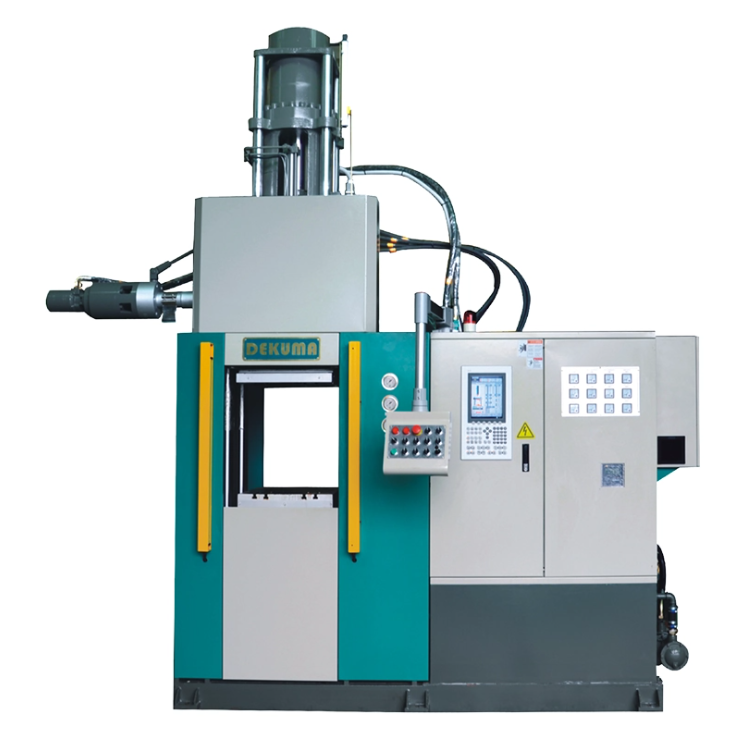
This principle can be seen in the RV-Se Series Rubber Injection Molding Machine from Dekuma. The series uses servo-hydraulic technology to control pressure and flow for TPV, TPE, flexible modified PVC, and other materials processed by injection molding. Its application focus includes demanding automotive production.

The machines are offered with clamping forces from 500 to 1,000 tons. The hydraulic system combines servo control with pressure and flow regulation to support stable molding cycles. The RV-Se Series is specified to consume approximately 40% of the electricity used by conventional proportional pressure and flow control systems, although actual savings depend on operating conditions.

This product example shows why energy-saving design should not be separated from molding performance. The aim is not simply to lower motor activity. The system must still provide the pressure and flow required at each stage while supporting stable cycles and repeatable production.

How Buyers Can Evaluate Energy Performance

Before purchasing a hydraulic press machine for rubber molding, buyers should compare energy use under representative production conditions. Rated power alone cannot show how the machine behaves during clamping, injection, holding, waiting, and pressure transitions.

Useful questions include whether the servo system changes output according to demand, how quickly pressure responds, and whether energy data can be monitored during production. Buyers should also compare machine performance using similar moulds, materials, cycle settings, and production targets.

Buyers should evaluate energy control alongside hydraulic stability and repeatability under representative production conditions. For B2B users, however, the practical decision should still be based on process requirements. Material type, part size, clamping demand, cycle frequency, and production volume should guide equipment selection.

Energy Efficiency as a Practical Production Metric

Energy efficiency is becoming part of equipment evaluation because it connects directly with operating conditions. With a servo hydraulic injection molding machine, manufacturers can reduce unnecessary hydraulic output when its control system closely follows real pressure and flow demand. The value is stronger when that reduction is achieved without sacrificing response or repeatability.

The same principle applies when evaluating a hydraulic press machine for rubber molding for long production runs. Buyers should examine energy use together with process stability, cycle behavior, material requirements, and clamping capacity. This approach turns energy efficiency from a marketing claim into a measurable part of production planning.

Designing Leak-Proof Battery Liquid Cooling Systems

Effective thermal management remains the cornerstone of operational longevity and safety for modern energy storage assets. As facility operators and grid managers face increasing density requirements, they require robust hardware capable of mitigating thermal runaway risks. Implementing a hypercubeC&I system ensures that every battery liquid cooling system operates within optimal temperature windows during rapid charge cycles, significantly reducing the probability of localized hotspots that degrade performance over time.

Engineering Principles for Hermetic Sealing

The fundamental goal of a high-performance cooling architecture is the absolute prevention of coolant ingress into sensitive battery modules. Engineers must prioritize the structural integrity of every connection point, utilizing advanced polymer gaskets made from specialized fluoroelastomers, which maintain a consistent compression set even under extreme vibration. By using ultrasonic welding to fuse thermoplastic components, they create reliable, durable interfaces that often perform more consistently than traditional adhesive seals, effectively minimizing the risk of micro-leaks.

Testing protocols for these systems demand rigorous validation processes under simulated field conditions to ensure durability. Engineers subject all plumbing assemblies to high-pressure stress tests that exceed standard operational thresholds, verifying that joints remain impervious to vibration or thermal expansion. This meticulous approach to hardware validation ensures that mechanical failures do not manifest as catastrophic leaks during the lifecycle of the storage installation.

Advanced Monitoring Systems

Modern thermal circuits now integrate sophisticated sensor networks to provide real-time visibility into fluid dynamics and system pressure. Detailed data logging allows operators to detect subtle variations in flow rate or pressure drops that indicate an early-stage failure. Automated alerts allow maintenance teams to intervene before a minor anomaly escalates into a significant issue, maintaining high availability for utility-scale applications.

These digital oversight mechanisms create a closed-loop system where data informs every aspect of maintenance. By utilizing smart sensors, they track the health of cooling pumps and valves continuously, ensuring that all subsystems operate within specified parameters. This granular level of control provides the necessary confidence for project developers to deploy energy infrastructure in sensitive locations where reliability is the primary prerequisite.

Integrating hypercubeC&I Solutions

The deployment of this advanced storage platform represents a significant step forward in managing thermal risks within commercial battery storage. This platform combines fluid cooling with intelligent control logic to ensure that every cell cluster operates efficiently. By minimizing temperature differentials across the entire pack, the system reduces the stress on battery chemistry, effectively extending the operational lifespan of the installation.

The integration process for the hypercubeC&I platform is streamlined to ensure that developers can commission these projects rapidly. This hardware is designed to function seamlessly within high-density environments where space is at a premium and cooling performance is critical, allowing operators to scale their infrastructure as energy needs fluctuate.

Material Selection for Corrosive Resistance

The chemical composition of cooling fluids must be compatible with internal tubing and metal housing materials to prevent gradual erosion or electrochemical reactions. Designers avoid metallic impurities that catalyze degradation, favoring specialized synthetic hoses and high-grade coolant formulations that remain stable over long periods. Proper selection of these materials serves as the first line of defense against the systemic corrosion that typically compromises cooling integrity.

Strategic engineering involves the elimination of complex pathing that increases the count of physical joints and mechanical weak points. By simplifying the internal architecture of the cooling loop, designers reduce the probability of seam fatigue and connection degradation during high-intensity operations. This focus on architectural efficiency ensures that the thermal solution remains robust against mechanical stresses induced by repetitive thermal cycling in industrial environments.

Maintenance Strategies and Reliability

Routine inspections remain a vital component of a comprehensive strategy for preventing leaks in dense energy storage facilities. HyperStrong empowers facility owners by providing detailed technical manuals and maintenance schedules that cover every aspect of the cooling infrastructure. Through consistent assessment of external seals and fluid levels, maintenance teams can identify signs of wear before the system loses its ability to regulate heat effectively.


System reliability depends on the quality of the components used by HyperStrong to assemble these thermal solutions for utility and industrial clients. By standardizing high-grade connectors and pressure-resistant tubing, they offer a foundation for operational excellence in demanding grid applications. These practices ensure that the cooling infrastructure remains a supportive asset rather than a hidden risk factor, facilitating sustainable energy management.

Future Proofing Thermal Infrastructure

As energy storage systems become more powerful, cooling requirements continue to evolve. Researchers are exploring various material science advancements to address future needs, including laboratory-stage investigations into polymers with passive repair characteristics. While these concepts are still in early stages, tracking such innovations helps operators remain informed about potential future avenues for mitigating structural fatigue or minor mechanical stresses within cooling loops.

The ability to maintain consistent cooling performance is crucial for the ongoing success of global energy transition goals. They leverage research and manufacturing excellence to provide solutions that meet the evolving requirements of the energy market. By focusing on innovation and high-quality construction, these cooling architectures serve as the backbone for stable, secure, and efficient energy storage deployments in every climate condition, supporting critical grid assets.

Conclusion

Securing the integrity of energy storage requires a holistic view of thermal management, encompassing both material science and intelligent monitoring. Deploying a high-quality battery liquid cooling system provides the necessary defense against thermal instability, while access to advanced platforms like hypercubeC&I ensures that operators maintain full control over their equipment health. Prioritizing these technical aspects is essential for delivering secure energy projects that serve the needs of the grid and commercial sectors effectively.